The card lies still. The stage does the moving.
Your card sits in a tray against a steel square, and a motorised stage carries it under a 4K camera. The stage moves by exact distances, so every pixel has a known size in millimetres.
HomeServicesPre-Grade
Grading fees add up, and not every card is worth sending. A BLACKLENS pre-grade goes over a card the way a grader would, then shows you everything it found, so you send the right cards to the right place.
Two people grade the same card. One says nine. One says eight and a half. Who is right?
That question is why BLACKLENS exists. Grading by eye is an opinion, and opinions do not show their working. So we set out to replace the opinion with a measurement wherever a measurement can do the job: fixed rules, logical deductions, and every point accounted for in a report you can read.
It began with the arithmetic: a spreadsheet of fixed rules for what each flaw costs, pillar by pillar.
A USB microscope and a ruler. Cards moved by hand, shot by shot, centering measured on screen. Hand-held shots never quite lined up.
Two stepper rails, a breadboard and jumper wires on a workbench. Now the card moved by exact distances, and the pictures fit together.
A 4K camera over a motorised stage, a steel square as the reference, overlapping shots stitched into one card, and reports published to BLACKVAULT.
The same bench learned to read a card through its sleeve, card saver, toploader or slab. Send it as it is.
Today the same bench feeds your Profile: each card’s report in BLACKVAULT, its place on BLACKBOARD and its value in BLACKPORT, from the day the box arrives.
Every card gets all of this. Nothing here is a mock-up: these are clips from the bench, and the numbers come from published reports.
Your card sits in a tray against a steel square, and a motorised stage carries it under a 4K camera. The stage moves by exact distances, so every pixel has a known size in millimetres.
The stage stops, settles, and the camera fires: 36 overlapping 4K shots per side. Watch the full-card preview fill in on the right. The shots are matched and stitched into one picture of tens of megapixels, with no seam that could read as a flaw.
Front and back get the same shots, the same frames and the same rules. An outer frame goes on the card’s edge and an inner frame on its printed border, and all four borders are measured on both faces.
Centering from the published report BL-00000345TH.
This is the part we do not shortcut. An inspector goes over every corner, all eight edges and the whole surface, zooming in and switching image modes that bring out what the eye misses. Each flaw is boxed, sized, classed major, minor or micro, and placed on the card’s map.
AI inspection is not part of the service yet. Every mark in every report today was placed by an inspector, on every card we take in.

Each pillar starts full, and points come off only for what was found. Here is a real one: this card lost 12 points on centering and 14 for its 13 marks. You can see exactly where every point went.
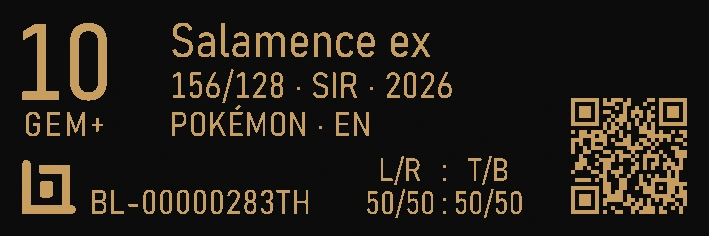
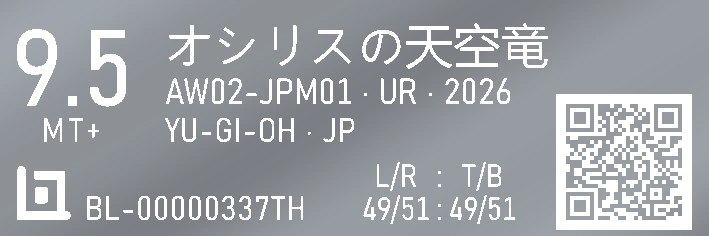
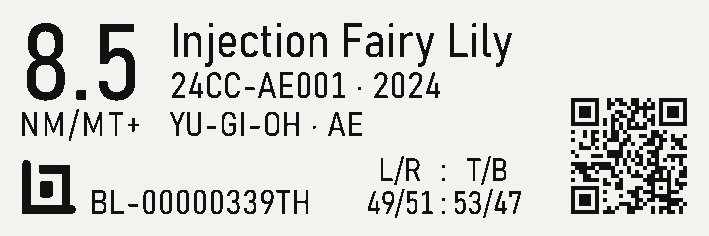
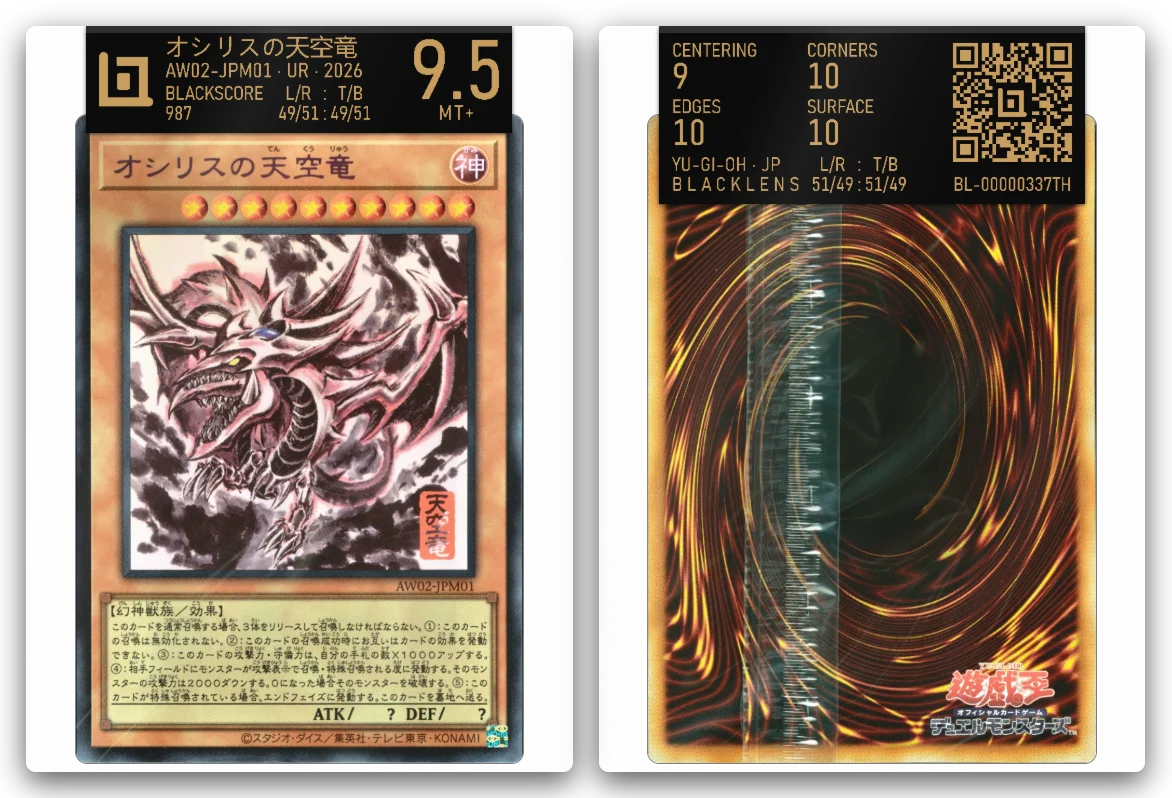
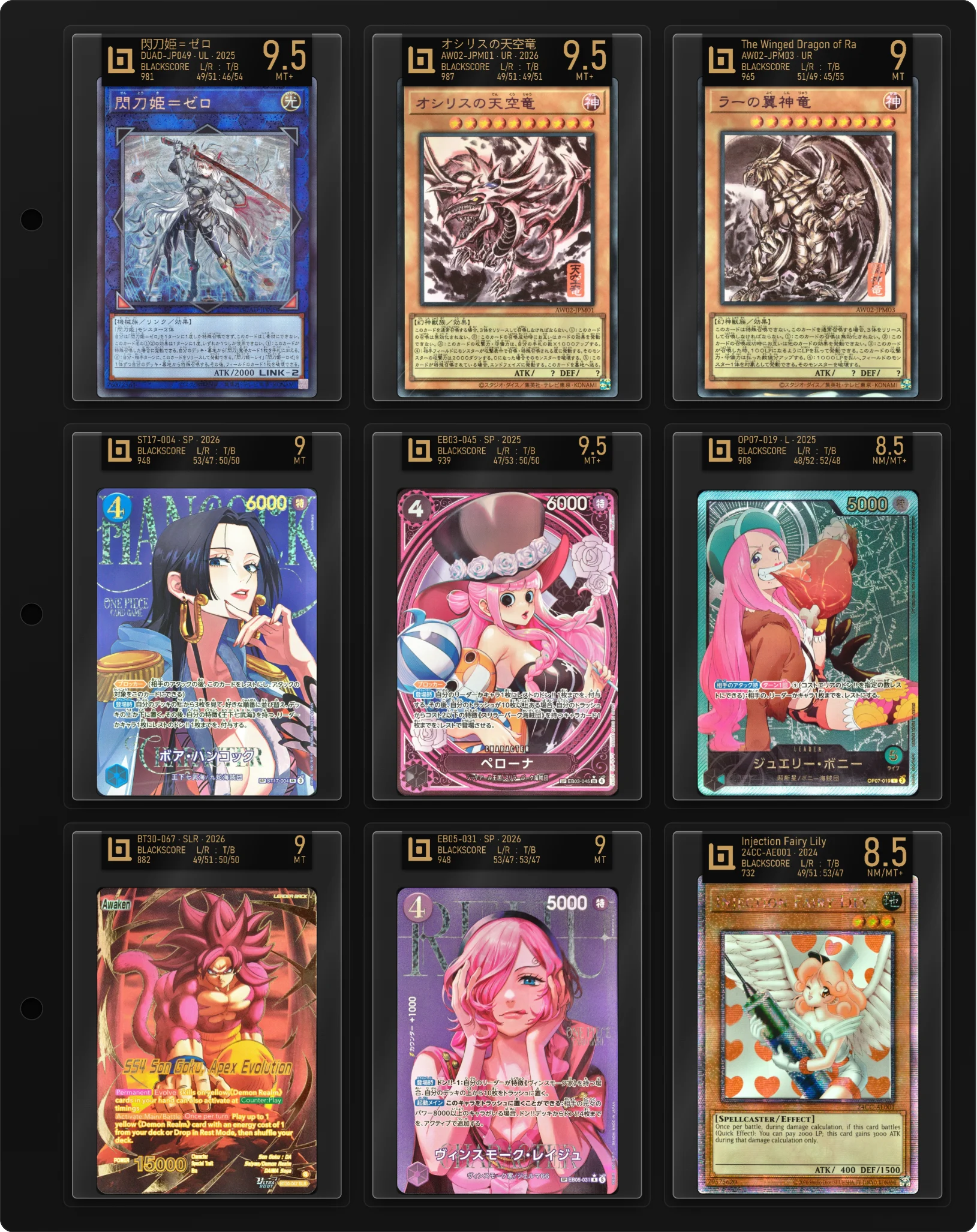
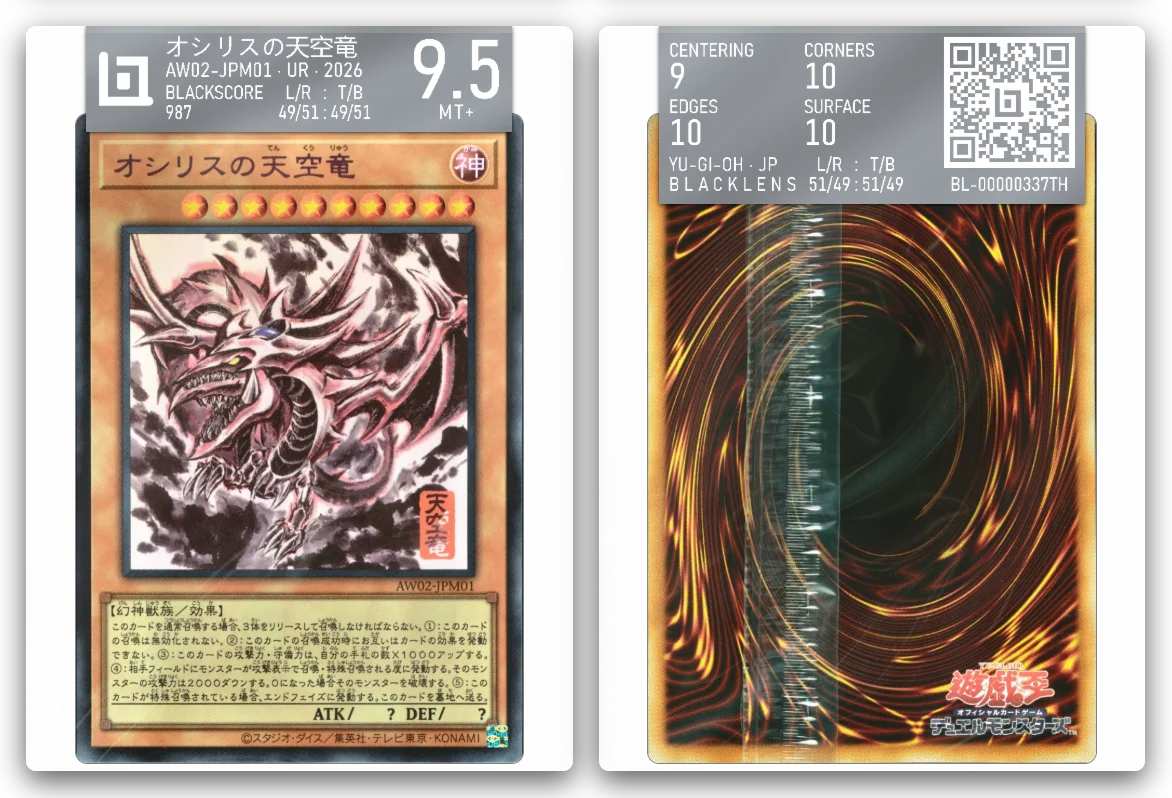
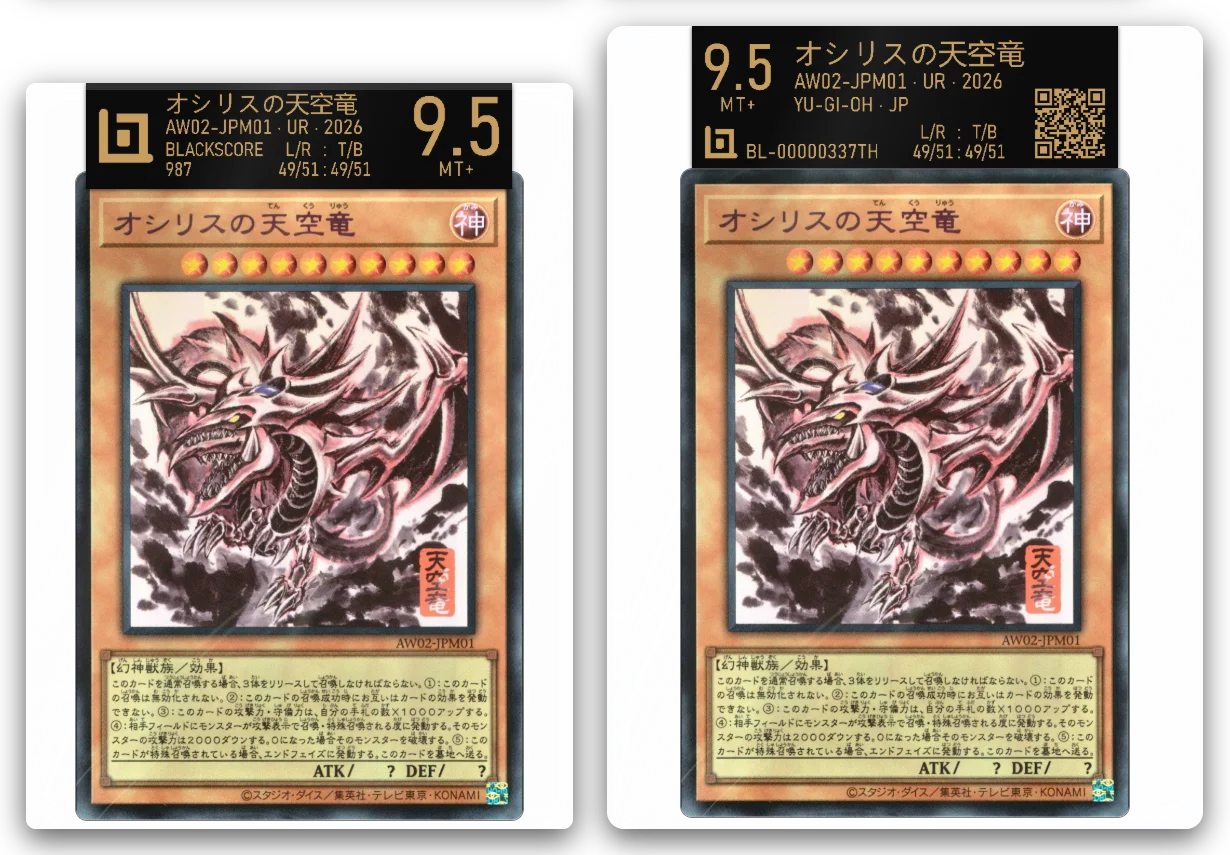
The label carries the grade, the BLACKSCORE, the centering, the four pillar grades, the Job# and a QR. Anyone can point a phone at the QR and open the full report in BLACKVAULT, with no account.
BLACKLENS 3.3 scans through sleeves, card savers, toploaders and graded slabs, and sealed cards can be verified. Send your cards in whatever they are in, and pre-grade them before you crack or regrade. Cracking is not done by BLACKLENS.
Every pre-graded card gets a Job# and a published report in BLACKVAULT.
A score out of 1000 and a grade from 10 to 1 for centering, corners, edges and surface. The four grades add up to the card’s grade on the BLACKLENS scale.
All four borders, the left/right and top/bottom ratios, and a score out of 100 per side.
How each grading company’s standard reads your card, side by side, as a prediction.
Four corners per side with their measured angles, and all eight edges as zoomable strips.
Every flaw boxed on the card’s map, classed major, minor or micro, pictured, with the points it took.
How many of the same printing we have pre-graded, at which grades, and how often it comes out a 10.


The real card saver label, front only, in each finish.
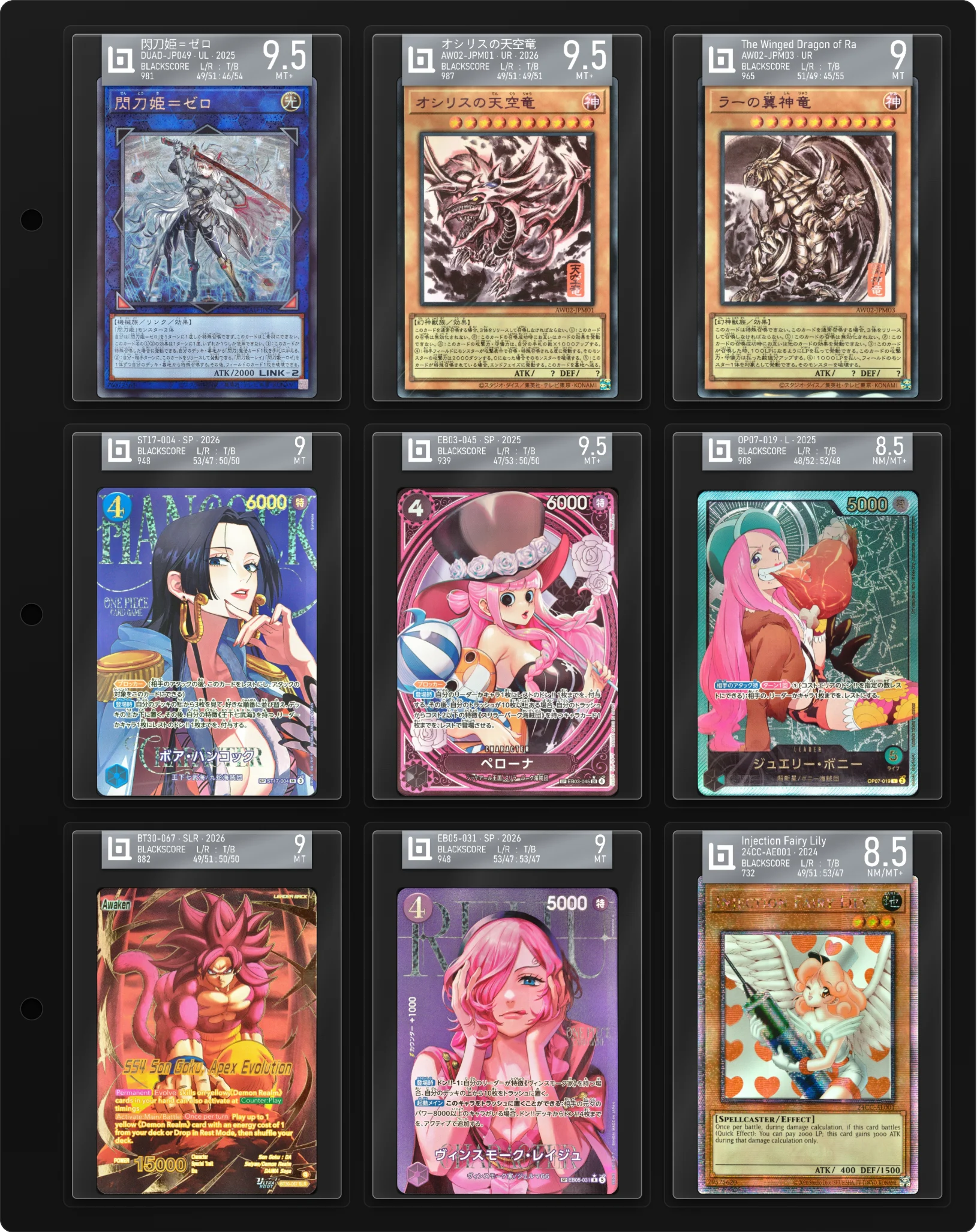
Three finishes, BLACK · GOLD, SILVER · WHITE and WHITE · BLACK, made for toploaders and card savers. Choose one for your cards, or let each card's grade choose. Your pre-grade stays with the card, and looks the part in a binder.


SILVER · WHITE is the same label with the same facts: white print on matte silver, with the QR on a white square of its own.

Pick the holder when you submit, and the label is made for it.
Fits about 80% of binders, for collectors and merchants alike. Slide it straight into a binder.
Usually for cards going on to grading next.

Everything happens in MY SUBMISSIONS, on your computer or in the BLACKLENS app on your phone.
Sign up with your email at blacklens.app. The same account opens BLACKBOARD and BLACKPORT.
Open MY SUBMISSIONS, press NEW SUBMISSION and choose BLACKLENS PRE-GRADE. Seats are limited, and the number left shows as you go.
Pick them from your BLACKPORT portfolio, find each one by its number or name, or just give the number of cards you are sending. Then declare what they are worth.
Drop the cards off on a date you choose, or send them by courier, and say how you want them back: collect, or courier to your address.
Check the cards, the fees and the terms, then SUBMIT REQUEST. You receive your drop-off pass, a request number with a QR, and a confirmation email.
Bring or send them with the pass, in whatever holder they are in. At check-in each card gets its own Job# and your request becomes an order.
Requested → arrived → received → inspecting → reported → grades ready → returned. Each step shows in MY SUBMISSIONS, and we email you as it happens.
Every report goes live in BLACKVAULT the moment it is published, then your cards come back as you chose.
Fees and turnaround are shown in your submission before you send it.
With the report in hand, every option is an informed one.
Pre-grade your cards with BLACKLENS.